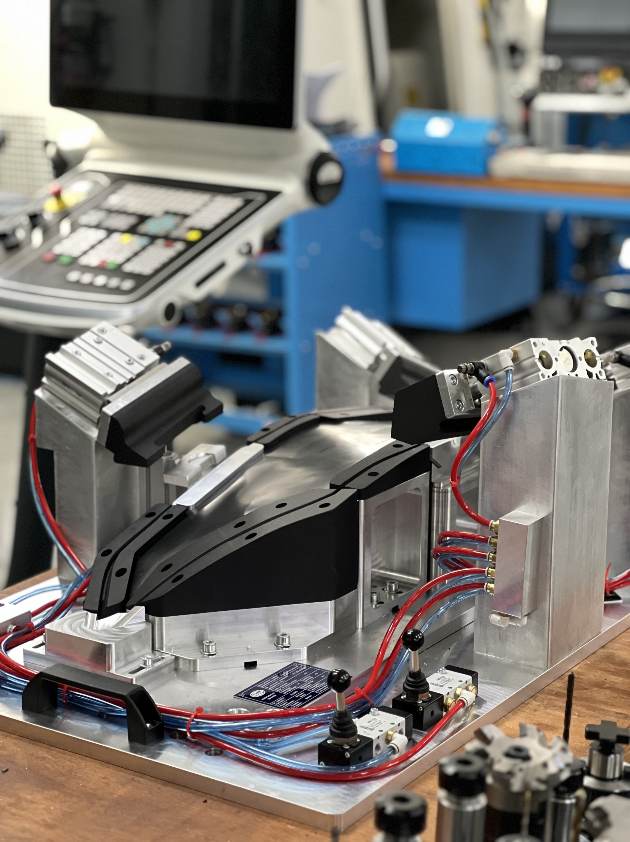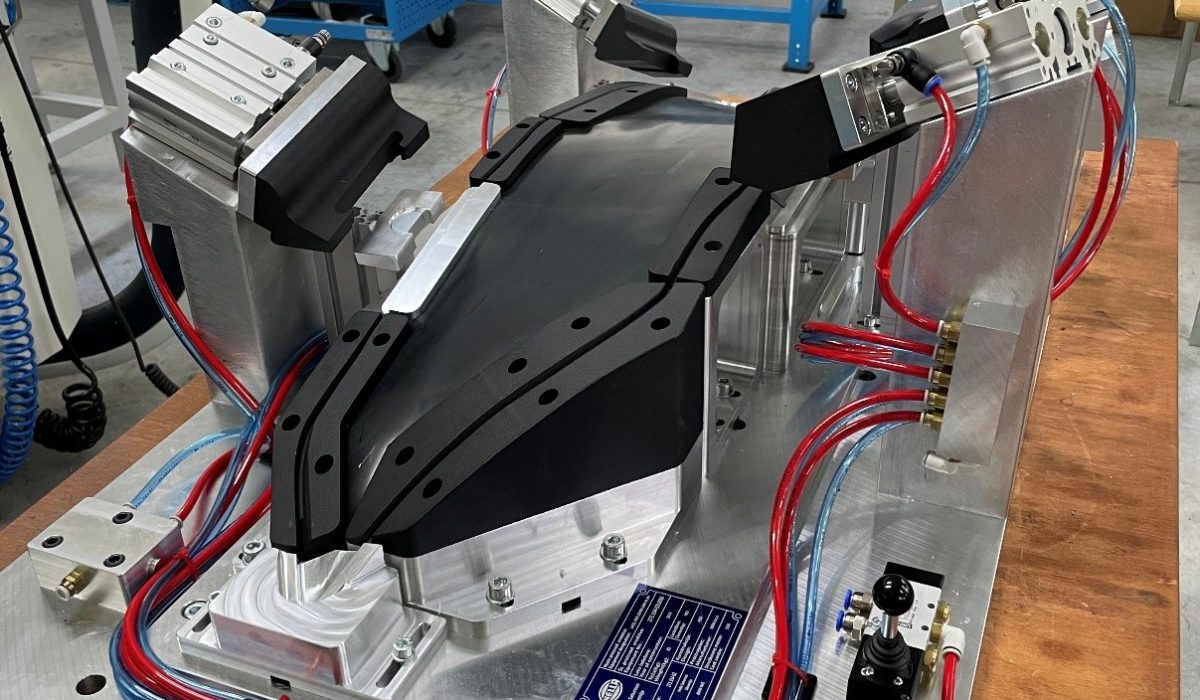
Milling Fixture
The manufacturing process of a pneumatic milling fixture begins with the design phase, where the positioning and clamping method of the workpiece is defined based on the workpiece geometry, required accuracy, and technological process. During this phase, a 3D model of the fixture is created, clamping positions, reference surfaces and pneumatic components are defined, and technical documentation for manufacturing individual components is prepared.
After the design phase is completed, standard components such as pneumatic cylinders, valves, fittings, positioning elements, screws and other standardized parts are ordered. Custom fixture components are then manufactured using CNC machining processes, ensuring the required dimensional accuracy, correct positioning of clamping elements and fixture stability during the milling process.
After all components are manufactured, the fixture assembly process follows. Mechanical and pneumatic components are assembled, clamping forces are adjusted and the proper operation of all moving parts is verified. In the final phase, the fixture is mounted on a CNC machine, test machining operations are performed, clamping stability and accuracy of manufactured parts are checked, and optimization is carried out if required before implementation into the production process.
Process steps:
1. Requirement analysis and design
- review of the workpiece 3D model and product requirements,
- definition of the machining process,
- selection of locating and clamping methods,
- determination of clamping forces,
- creation of the fixture 3D model,
- preparation of drawings and bill of materials.
2. Ordering of materials and standard components
- selection of suitable material for the base plate and fixture components,
- ordering of standard components:
- pneumatic cylinders,
- valves and fittings,
- guide elements,
- centering and positioning elements,
- fastening components.
3. Manufacturing of fixture components
- creation of CAM programs,
- CNC milling of individual components,
- machining of holes and threads,
- manufacturing of reference surfaces,
- inspection of critical dimensions.
4. Fixture assembly and adjustment
- assembly of mechanical components,
- connection of the pneumatic system,
- adjustment of positioning and clamping,
- verification of cylinder movement,
- inspection of clamping repeatability.
5. Production testing
- mounting the fixture on a CNC machine,
- setting of zero points,
- performing test machining operations,
- measurement of manufactured parts,
optimization of the machining process.